 Pueblo Stucco Repair
 Stucco Patching in Pueblo
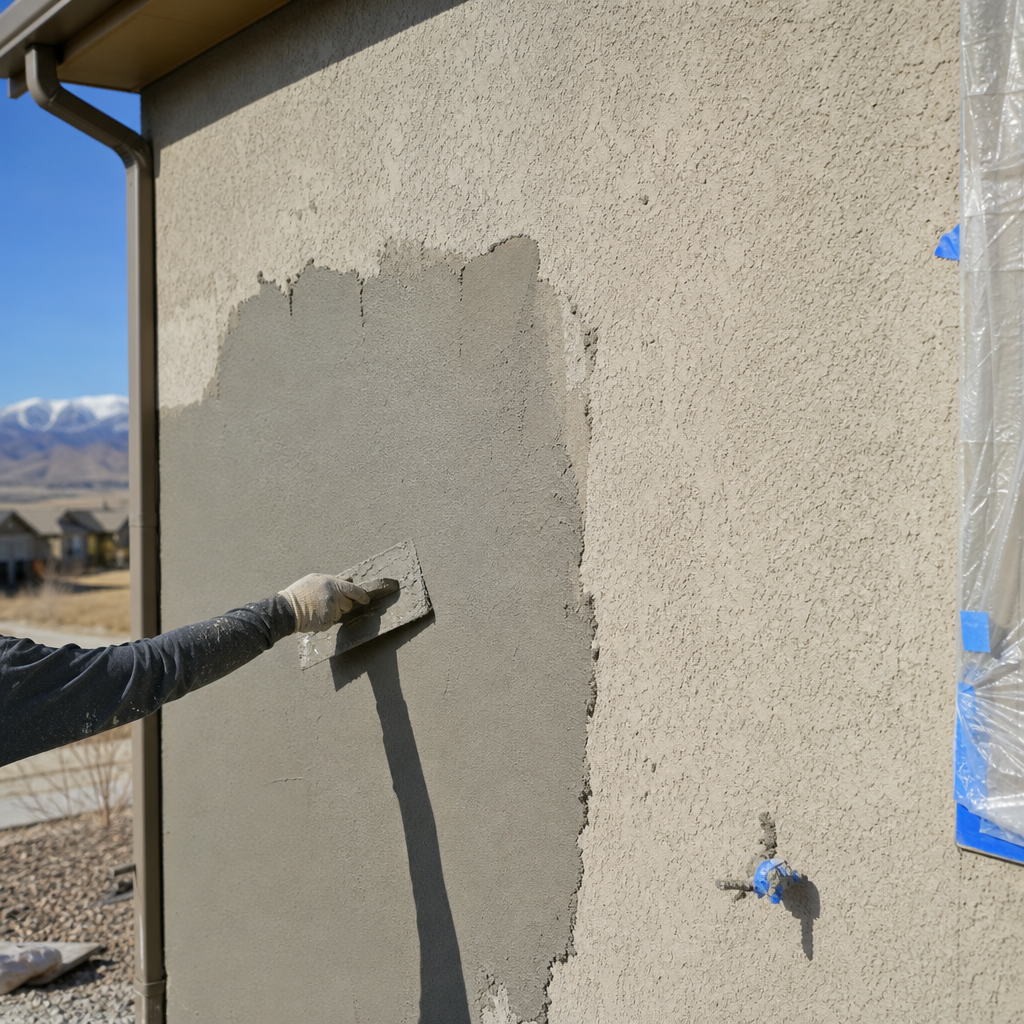
Stucco patching in Pueblo runs $500 to $2,000 for typical jobs, with larger areas priced at $8 to $15 per square foot. A patch is what a crack fill cannot do: the failed stucco is cut back to sound material, the paper and lath behind it are inspected and replaced, and the wall is rebuilt in coats until it sheds water again. It is the repair that hollow walls, blowouts, freeze spalls, and water-softened areas actually need, and it is where cheap repairs fail first.
If you can push a screwdriver into your stucco, if it sounds hollow when tapped, or if you can see wire through a hole, you are on the right page.
What fails in Pueblo, and why it fails as a patch
Freeze-thaw delamination. This is the Pueblo signature. Water gets behind the finish coat through a crack or a failed sealant joint, freezes on one of the roughly 165 nights a year the airport station records at or below 32 degrees, and expands. The ice lifts the finish off the brown coat, or the brown coat off the scratch coat. By spring the area sounds hollow, and by the following spring it has spalled off in dish-shaped flakes. NOAA’s normals show why the cycle is so relentless here: a January normal high of 48.4 and low of 15.4 means the wall thaws and refreezes almost daily for months.
Hail blowouts. Colorado’s hail season runs mid-April to mid-September, and Pueblo is squarely in it; NOAA’s billion-dollar disaster list carries a June 13, 2018 entry for hailstorms in Colorado Springs and Pueblo with severe damage to homes at an adjusted cost of $1.2 billion. On a thick three-coat wall hail pits the finish. On a 1/2 inch one-coat wall, the kind that clads most of Pueblo West, a two-inch stone can punch through to the foam. Those holes are patches, not crack fills, and they get worse fast because the next rain goes straight in.
Water-softened wall bases. Downspouts that discharge at the foundation, sprinklers that hit the wall, and grade that slopes toward the house all keep the bottom foot of stucco wet. The tell is white efflorescence bloom, then staining, then soft, crumbling material. On older homes with stucco run down to the dirt (a pre-code detail common in the Mesa Junction and Bessemer grids and in some 1950s Belmont ranches) the wall drinks from the ground continuously.
Rusted lath and rotted paper. Once water has lived behind the stucco for a couple of seasons, the galvanized lath rusts and the weather-resistive paper rots. At that point the stucco has nothing to hold on to, and it fails in sheets. This is the version that lands at the top of the price range, and the version that a skim-coat “repair” guarantees. If the damage is along the bottom of the wall where a patio or slab was just removed, see stucco damaged at grade after patio removal. If the hole is where a side-draft swamp cooler used to sit, see patching the hole a swamp cooler left.
How a proper patch goes
- Sound the whole elevation, not just the hole. Tap outward from the visible failure until the wall sounds solid again. The patch boundary is where the sound changes, not where the damage looks like it stops. Underscoping here is why some patches fail at their edges within a year.
- Saw-cut a clean boundary and demo to sound material. Straight cuts give the new material a clean edge to bond to and make the finish blend cleaner. Everything loose comes out. Rusted lath and rotten paper come out with it.
- Rebuild the weather barrier. New paper lapped shingle-style into the existing paper above and below, so water running down the wall stays outside. New galvanized lath tied into the existing. Flashing corrected at any window, penetration, or trim band the patch touches. This is the step cheap patches skip, and it is the only step that matters for keeping water out.
- Scratch coat and brown coat, moist-cured. Cement basecoats need water to cure properly, and Pueblo gives them 12.02 inches of rain a year and relative humidity that often sits in the teens on summer afternoons. The coats should be fogged during cure rather than letting the desert flash-dry them. The brown coat is floated flush and left to sit before finishing.
- Finish coat, texture, and color. The finish replicates your texture and feathers into the surrounding wall. We blend color against the weathered wall and only judge it once dry, in daylight. The color and texture matching page explains what is achievable on a faded elevation and what is not.
- Fix the cause. A patch under a downspout gets a downspout extension. A patch beside a sprinkler gets the head redirected. A patch at a wet wall base gets a conversation about grade. Skip that step and the patch is a subscription.
Patching by wall system
- Three-coat over frame: the full sequence above. Standard on most Pueblo homes stuccoed before about 2000.
- Three-coat over block: no paper or lath, the scratch coat bonds directly to the block after the failed material is removed. Mesh goes across any mortar joint that has moved, because block walls move at their joints. Common across Belmont, Sunset Park, and the 1950s to 70s ring.
- One-coat over foam: the foam sheathing behind the failure gets inspected; wet or crushed foam is replaced before the new basecoat goes on. Most of Pueblo West and the newer subdivisions on the city’s edges.
- EIFS: patched with EIFS components only. Foam board, polymer basecoat with embedded mesh, acrylic finish. Cement stucco in an EIFS wall is a defect that traps water against the foam. If a bidder does not ask which system you have, they are pricing blind.
- Stucco over brick: a later skin on a Mesa Junction or Bessemer house. The patch bonds to the brick, but if the brick’s mortar has failed, repointing comes first or the patch cracks along the same line.
What it costs
| Scope | Range |
|---|---|
| Typical patch (hollow area, blowout, spall) | $500 to $2,000 |
| Larger patch areas | $8 to $15 per sq ft |
| Service minimum (most crews) | $300 to $500 |
The range is wide because the visible damage is not the real damage. A clean hail blowout on a garage wall is the bottom. A downspout stain that turns out to have rotted the paper and rusted the lath down half a wall is the top. What a good quote does is name the cut-back, the paper and lath, and the coats, so you can compare it line by line against any other bid. The pricing page has the whole table. If you have several hollow spots on one elevation, ask about a recoat instead; past a certain density of patches, rebuilding the whole face is cheaper and looks better.
Timing
Patching is cement work, and cement should not go on when temperatures are heading toward freezing. NWS Pueblo puts the mean last spring freeze at April 29 and the mean first fall freeze at October 8, so late April through October is the honest window. A blowout discovered in November gets a temporary weather seal and a spring date on the calendar, and you will hear that rather than a rushed finish coat that shrink-cracks in January.
Patching is covered across Pueblo and out to Pueblo West, Colorado City, Penrose, Florence, and Cañon City. Send a wide shot of the elevation, a close-up of the failure, and a photo of whatever sits above it, so we can come back with a diagnosis and a number. Process questions are on the FAQ.
Frequently Asked Questions
How much does stucco patching cost in Pueblo?
Typical patches run $500 to $2,000, with larger areas at $8 to $15 per square foot depending on the system and access. The visible hole is rarely the whole job; what turns up after cutting back to sound material sets the final number. Photos get you a realistic range before anyone shows up.
Why does my stucco sound hollow when I tap it?
The finish or basecoat has delaminated from what is behind it. In Pueblo that is usually freeze-thaw: water got behind the coat through a crack, froze, and lifted it. Hollow stucco has to come out; skimming over it is paying for a repair over a failure.
Can you patch stucco over concrete block?
Yes, and it is common here since much of Pueblo's 1950s to 70s housing is stucco directly over block. The patch bonds to the block with a scratch coat after the failed material comes off, and mesh goes across any mortar joint that has moved. If the block itself is cracked, that gets addressed first.
How long does a patch take?
At least two visits. The cut-back, paper, lath, and scratch coat go in on day one, the brown coat follows and is left to cure, and the finish coat comes last. Rushing the cure is how patches shrink-crack in a season. In Pueblo's dry air the basecoats should be moist-cured rather than left to the weather.
A greenhouse or patio cover was attached to my stucco wall and has been taken down. Can the wall be patched?
Yes, and it is a patch job, not a crack fill. Removing an attached structure leaves ledger bolt and fastener holes that go through the stucco and usually through the paper and lath behind it, plus any flashing that was sealed to the wall. Each hole is cut back to sound stucco, the paper and lath are repaired so water cannot follow the old bolt path, and the area is rebuilt in coats. The strip that sat behind the structure has usually weathered differently from the rest of the wall, so a patch alone can leave a visible outline; the fix is finishing the whole wall panel from corner to corner or coating it (see color and texture matching). Photos of the wall with the structure gone, including the bolt holes, get you a range before a visit.