 Pueblo Stucco Repair
 Restucco and Recoating in Pueblo
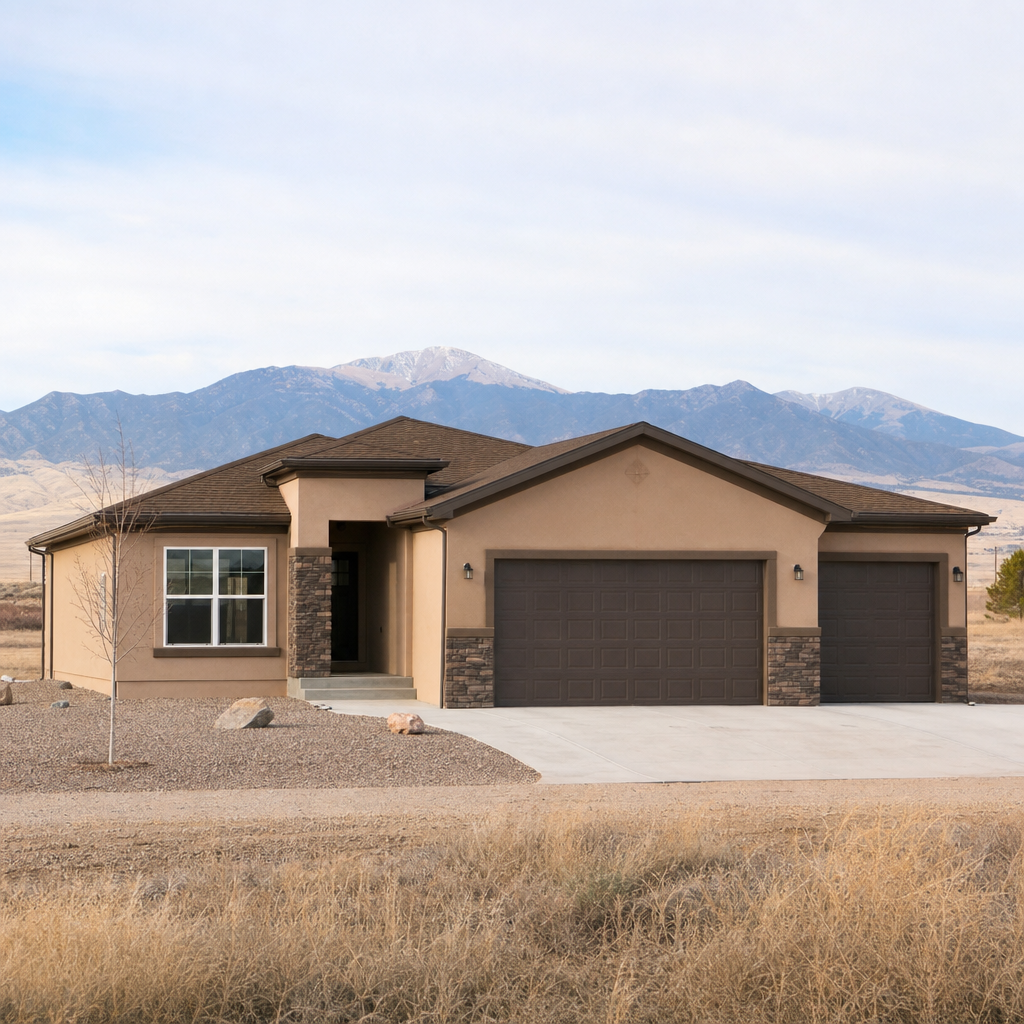
Recoating in Pueblo runs $3 to $6 per square foot for a new finish coat over a sound base, and a full restucco runs $6 to $9 per square foot (standard finish) or $10 to $14 (smooth or specialty). Whole-house restucco commonly lands at $12,000 to $20,000; one or two elevations at $3,000 to $8,000. Which one you need is a structural question about the base coats, not a cosmetic one about the finish, and that is the first thing to sort out from photos and a sounding.
Pueblo is an older city, and a lot of its stucco is tired. The median home in Pueblo County dates to 1974, and HUD’s 2025 housing market profile counts about 55 percent of the owner-occupied single-family stock as built before 1980. Walls that have taken 40 or 50 years of this climate are the ones this page is about.
What an exhausted Pueblo wall looks like
Chalky, faded finish. Pueblo gets close to 3,470 hours of sunshine a year, and the UV degrades pigmented finish coats until they chalk off on your hand. South and west elevations go first.
Map cracking across whole elevations. The 32.5 degree average daily swing works the finish coat through every cycle, and after decades the accumulated stress shows as a spiderweb across the entire face. Chasing those lines individually is a losing game; the finish is done.
Hail pitting. Colorado’s hail season runs mid-April to mid-September, and Pueblo’s storms leave a signature: hundreds of small pits across a west or south face, each one a spot where the finish is now thinner and looser. One pitted elevation is a recoat candidate. Scattered pits are a patch.
Freeze spalling. Water behind the finish coat froze on one of the roughly 165 nights a year at or below 32 degrees and lifted the finish in dish-shaped flakes. A few spalls are patches. Spalling across a face means the finish has lost its bond, and a recoat over what remains will lift with it.
Patchwork. An elevation that has been patched five times in five colors. At some density of patches, rebuilding the face is cheaper than the sixth patch and looks like a wall again.
Recoat versus restucco: the honest decision
A proper sounding taps the whole house. Not the bad wall, the whole house. What it listens for is the base coats.
If the base coats are sound (the wall rings solid everywhere, the cracks are finish-deep, no staining, no soft spots at the base), a recoat is honest. The old finish is cleaned, any loose material is removed, cracks are keyed and filled, a bonding agent goes on, and a new cement finish coat is applied at the texture you choose. On a wall with widespread hairline map cracking, an elastomeric coating is the other honest option, and often the cheaper one.
If the base coats have failed (hollow areas across the face, rusted lath showing at spalls, staining from water that has lived in the wall, a soft wall base), a recoat is burying a problem. The new finish bonds to a base that is letting go of the lath, and it comes off with the base. The real answer is a full restucco: strip to the lath or sheathing, replace rusted lath and rotten paper, correct flashing, and rebuild scratch, brown, and finish coats. It costs more because it is more, and it is the only version that lasts.
A recoat over a failed base is a bad buy. So is a full restucco when a $4-a-foot recoat does the job. The sounding decides, and you can stand there while it happens.
How a full restucco goes in Pueblo
- Strip. Old stucco comes off to the lath on a three-coat wall, to the sheathing on a one-coat wall, or to the block on a block wall. This is loud, dusty, and takes a day or two on a typical single-story.
- Inspect and correct. Rusted lath is replaced. Rotten paper is replaced. Rotted sheathing, which turns up more often than anyone likes on the downspout side of a house, is replaced. Flashing at windows, doors, and trim bands is corrected, and a weep screed is installed at the wall base where the original builder ran stucco to the dirt.
- Scratch coat. Cement basecoat pushed into the lath and scored horizontally for the next coat to key into. Moist-cured; in Pueblo’s dry air that means fogging it rather than trusting the weather.
- Brown coat. Floated flush to the plane of the wall. On a smooth-finish job this coat has to be dead flat, which is where the $10 to $14 premium comes from. Left to cure before finishing; rushing it is how walls shrink-crack in the first winter.
- Finish coat. Pigmented cement finish or acrylic finish at the texture you chose: sand float, dash, skip trowel, lace, or smooth. Color judged dry, in daylight.
A recoat is steps 4 and 5 without the strip, plus surface prep and a bonding agent. Both are cement work, and neither should go on when temperatures are dropping toward freezing. May through September is the honest window in Pueblo.
By wall system
- Three-coat over frame or block: the full sequence above. Most of the city’s pre-2000 stock, including the stucco-over-block ranches of Belmont and Sunset Park.
- One-coat over foam: the 1990s and newer tract homes of Pueblo West. A recoat is common here after hail. A full restucco means new foam sheathing where the old is crushed or wet, then a new one-coat basecoat and finish.
- EIFS: recoated with an acrylic EIFS finish over a polymer basecoat, never with cement. If the EIFS has been trapping water, the foam comes off and the wall is rebuilt in the same system.
- Stucco over brick: in Mesa Junction and Bessemer, a stucco skin over 1880s to 1960s brick. Sometimes the honest recommendation is to remove the stucco and repoint the brick rather than restucco.
What it costs
| Job | Rate | Typical whole home |
|---|---|---|
| Cement recoat (finish over sound base) | $3 to $6 per sq ft | Depends on wall area |
| Full restucco, standard finish | $6 to $9 per sq ft | $12,000 to $20,000 |
| Full restucco, smooth or specialty | $10 to $14 per sq ft | Higher |
| Partial restucco (1 or 2 elevations) | By area | $3,000 to $8,000 |
Wall area, not floor area, is what you are buying. A 1,600 square foot single-story ranch typically has somewhere around 1,800 to 2,200 square feet of stucco once you subtract windows and doors and add gables. Access matters: two-story homes and the walk-out lots in Pueblo West cost more per foot for scaffolding. The pricing page has every number on the site. Permits: since January 1, 2026, city work goes through the Southern Colorado Building Department and unincorporated-county work through the Pueblo County Building Division; a full restucco is the kind of scope that may need one, and the contractor should confirm before starting.
One honest caution about partial jobs
A fresh south elevation next to a 20-year-old east elevation will not match, and no amount of color work makes new cement look sun-faded. The options are to accept the difference, fog-coat the adjacent walls to bring them closer, or do the whole house. Know this before the quote, because it is the number one complaint people have about partial restucco from crews who did not warn them.
Recoat and restucco work is covered across Pueblo and out to Pueblo West, Colorado City, Penrose, Florence, and Cañon City. Send photos of every elevation and ask for an honest call on recoat versus restucco and a number for each. The FAQ covers timing and permits.
Frequently Asked Questions
What does it cost to restucco a house in Pueblo?
A cement recoat over a sound base runs $3 to $6 per square foot. A full restucco, everything off to the lath or sheathing and rebuilt, runs $6 to $9 per square foot for a standard finish and $10 to $14 for smooth or specialty finishes. Whole-house jobs commonly land at $12,000 to $20,000; one or two elevations at $3,000 to $8,000.
Recoat or full restucco, which do I need?
It depends on the base coats, not the finish. If the wall sounds solid everywhere and the problem is a chalky, faded, map-cracked, or hail-pitted finish, a recoat is honest. If the base coats have delaminated, the lath is rusted, or water has been living in the wall, a recoat buries the problem and a full restucco is the real answer. The whole house should be sounded before quoting.
Can you restucco just the south and west walls?
Yes, and in Pueblo it is often the smart buy. South and west elevations take the most sun, the widest daily swing, and most of the hail, so they fail first. Partial jobs run $3,000 to $8,000. The catch is color: a fresh elevation next to a 20-year-old one will not match exactly, and you should hear that before, not after.
How long does a restucco take, and when?
A whole house is typically one to two weeks of site time with cure periods between coats. Cement should not go on in freezing temperatures, and NWS Pueblo puts the mean last spring freeze at April 29 and the mean first fall freeze at October 8, so restucco is a May through September job here.