 Pueblo Stucco Repair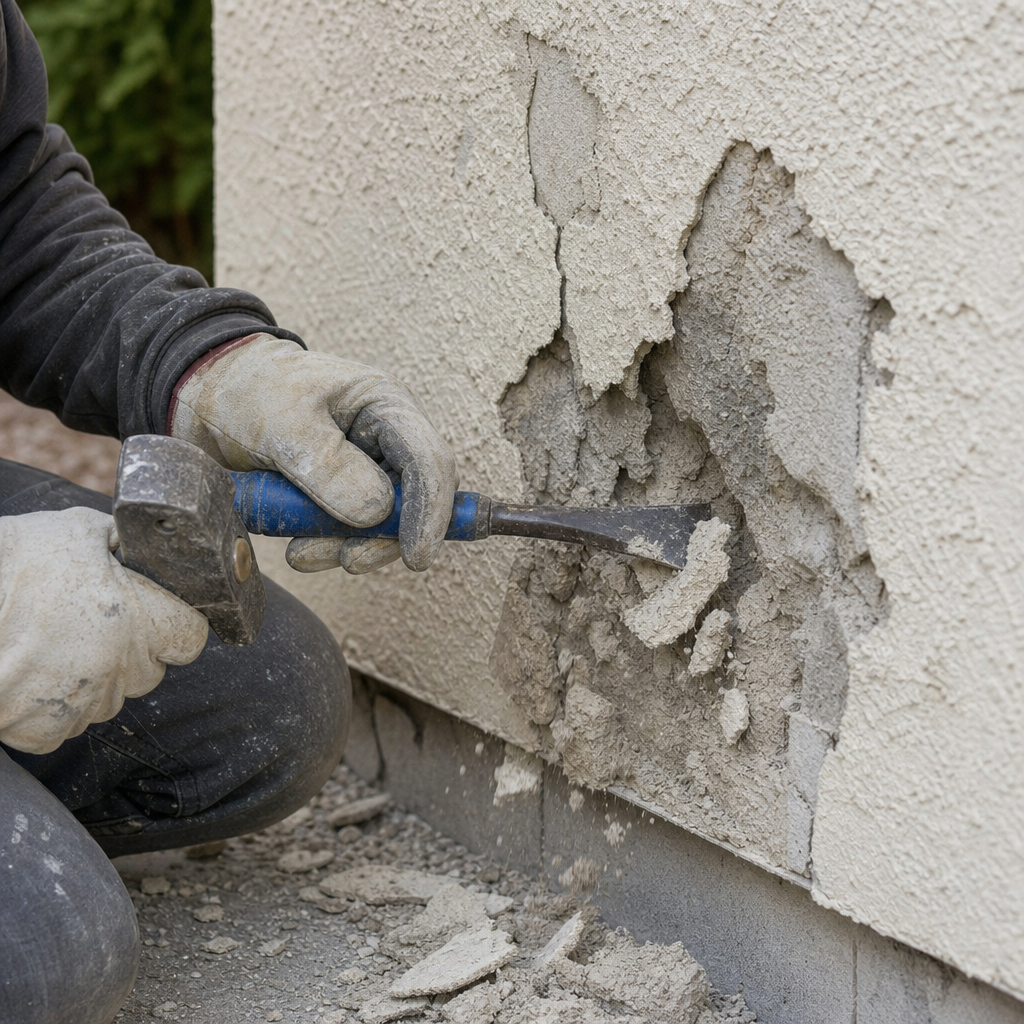
Pueblo Stucco Repair fixes cracked, spalling, hail-pitted, and failing stucco walls for homeowners in Pueblo, Pueblo West, and the lower Arkansas Valley. Typical crack repairs run $200 to $800, patching $500 to $2,000, elastomeric coating $1.50 to $3.50 per square foot, and a full restucco $6 to $9 per square foot. Send a few photos of the damage and we send back an honest quote without a sales walk-through.
Two things break stucco in Pueblo, and they take turns. Winter freeze-thaw opens the cracks. Summer hail pits and spalls what winter weakened. Everything we do is built around fixing that cycle properly, with the right system for the wall, instead of smearing caulk over it.
What gets repaired
- Stucco crack repair: hairline to structural cracks cut back, filled with a compatible material, and refinished so water stays out.
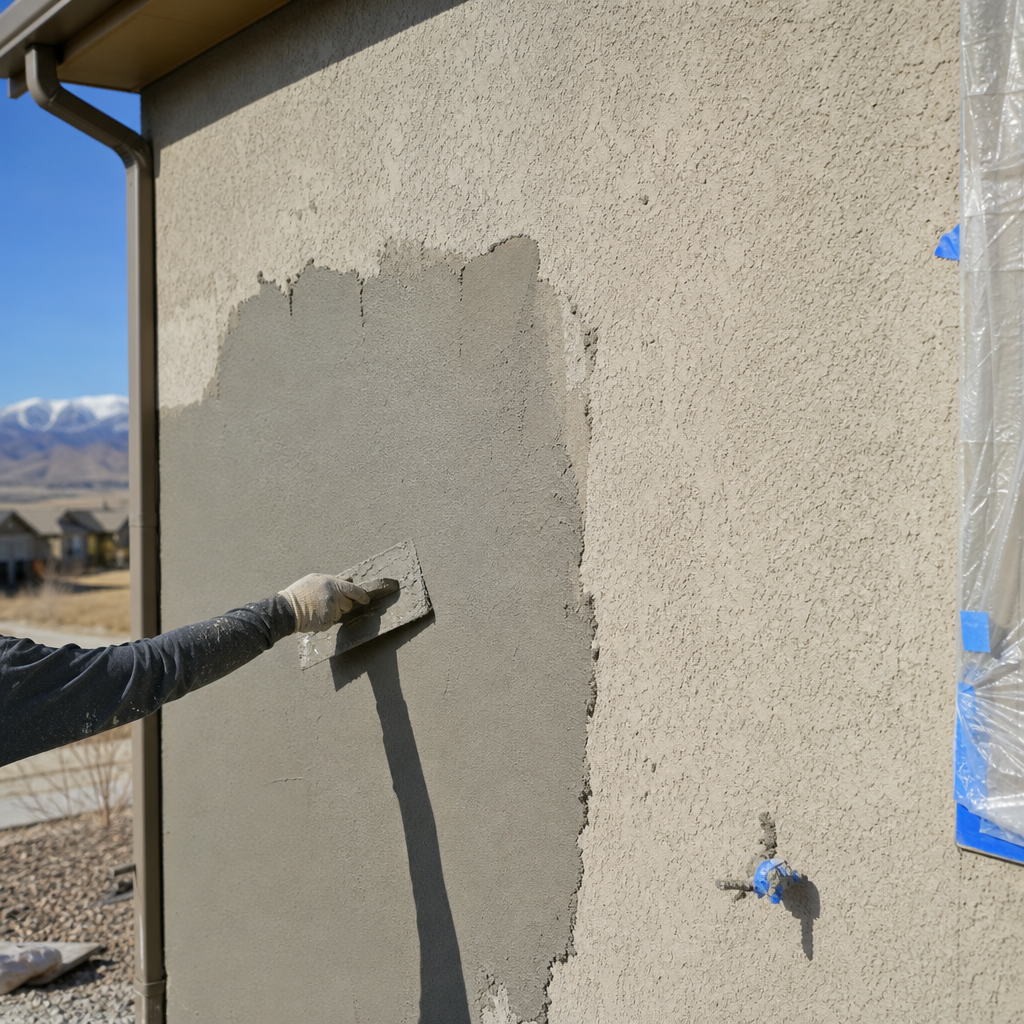
- Stucco patching: where the wall sounds hollow, has let go, or has blown out, we rebuild it over new paper and lath in cement coats instead of skimming it.
- Hail and freeze damage repair: pitted, spalled, and delaminated finish rebuilt after a storm or a hard winter, with documentation your insurer can read.
- Restucco and recoating: for a wall too far gone to patch, a fresh finish coat or a full restucco.
- Elastomeric coating: a flexible waterproof membrane that bridges map cracking across a whole elevation.
- Color and texture matching: we blend each fix into the sun-weathered wall so it does not stand out.
Why Pueblo is hard on stucco
The freeze-thaw engine runs all winter. Pueblo sits at 4,692 feet, and the NOAA 1991-2020 normals published by the National Weather Service office here tell the story: a January normal high of 48.4 degrees and normal low of 15.4, with the airport station logging about 165 days a year when the low reaches 32 degrees or colder. That is not one long freeze. It is a thaw nearly every afternoon and a freeze nearly every night for months. Water sitting in a hairline crack expands roughly 9 percent when it freezes, pushes the crack edges apart, melts by noon, and pulls in a little more water for the next night. A cosmetic hairline in October is an open crack by March. Where water got behind the finish coat, the ice lifts the finish off the brown coat and it spalls away in dish-shaped flakes.
The daily swing is one of the widest in the country. Pueblo’s average diurnal temperature range is 32.5 degrees across the year. A cement finish coat expands and contracts through every one of those cycles, and over 15 or 20 years the accumulated stress relieves itself as map cracking, the fine spiderweb pattern you can find on almost any older elevation in Belmont or Sunset Park.
Hail season is not a rumor here. Colorado’s hail season runs mid-April to mid-September, the Front Range sits in the heart of what insurers call Hail Alley, and the state ranks second only to Texas for hail insurance claims, with more than $5 billion in insured hail damage over the past decade according to the Rocky Mountain Insurance Information Association. NOAA’s billion-dollar disaster list carries a June 13, 2018 entry for hailstorms in Colorado Springs and Pueblo that caused severe damage to homes, businesses, and vehicles, at an adjusted cost of $1.2 billion. Storm reports collected near Pueblo logged golf-ball hail, 1.75 inches, as recently as August 2025. Hail that size does not just dent gutters. It pits acrylic finishes, cracks thin one-coat systems, and blows out spots that freeze-thaw had already loosened. See the hail and freeze damage page for what that looks like on a wall and how a proper repair goes.
The ground moves. The Colorado Geological Survey calls expansive soil the state’s most significant geologic hazard, one that causes more property damage than any other natural hazard. In the lower Arkansas Valley the NRCS maps soil series like Limon, a fine smectitic soil formed from clay and shale alluvium with 35 to 60 percent clay, and Manzanola, another fine smectitic series of large extent across eastern Colorado. Smectite is the clay that swells when wet and shrinks when dry. A foundation riding on that ground moves with the seasons, and the stucco above it shows it as stairstep cracks along block joints and diagonal cracks off window corners. Patching those without understanding the cause is how you pay twice.
Water is scarce, then arrives all at once. Pueblo’s normal annual precipitation is only 12.02 inches, but 2.11 inches of it falls in August alone, mostly in afternoon thunderstorms that drive rain sideways into walls that have baked since May. Open cracks drink it. Failed sealant at windows drinks it. That water is what freezes in December.
Pueblo’s housing stock, and what it means for your wall
Pueblo is an older city. The median home in Pueblo County was built in 1974, and HUD’s April 2025 housing market profile counts roughly 24,000 owner-occupied single-family homes, about 55 percent of the ownership stock, built before 1980. The stucco you find depends on the neighborhood:
- Mesa Junction and Bessemer: Pueblo’s oldest grid, homes from the 1880s through the 1960s around the old streetcar junction on Abriendo Avenue, and the small Minnequa Town Company houses built for steelworkers near the CF&I mill (the ones on Spruce Street date to 1902). Original walls here are mostly brick and frame; the stucco you see is often a later skin over brick or frame, and it fails where the substrate behind it moved.
- Belmont, Sunset Park, and the mid-century ring: Belmont built out from the 1950s in mid-century ranch style, and Sunset Park went from dairy farms, fairgrounds, and an airport before the 1950s to a suburb of 1950s and 60s mid-century moderns and bi-levels. This is where cement stucco over concrete block is common. Block moves at the mortar joints, and the stucco telegraphs it.
- Pueblo West and the newer tract stock: Pueblo West grew from about 2,000 residents in 1974 to 33,086 in 2020, so most of its 12,533 housing units are 1990s and later. That means one-coat cement over foam sheathing, foam trim bands, and acrylic finishes, all thinner and more hail-vulnerable than a three-coat wall. More on the Pueblo West page.
Three stucco systems, three different repairs
Getting the system right before touching the wall is half the job:
- Traditional three-coat: paper, wire lath, then roughly 3/4 inch of cement scratch and brown coat plus a finish coat. Most Pueblo homes stuccoed before about 2000.
- One-coat: a single roughly 1/2 inch cement basecoat over foam sheathing. Common on 1990s and newer production homes in Pueblo West and the newer subdivisions on the city’s edges. Thinner, so hail impacts and cracks telegraph faster.
- Synthetic (EIFS): foam board, fiberglass mesh in polymer cement, acrylic finish. Softer, dents from hail, and traps water badly when sealant joints fail. We fix EIFS only with EIFS parts and cement stucco only with cement; mixing the two is a defect.
How we repair a Pueblo wall, step by step
- Sound the wall and find the cause. Tap for hollow spots, trace cracks to their source (foundation, block joint, window corner, a downspout dumping at the wall base, a sprinkler) and identify the system before anything gets cut.
- Cut back to sound material. We saw-cut and chip out failed stucco until we are past the damage you can see. Rusted lath and rotten paper come out. Nobody skims over a soft spot.
- Rebuild the weather barrier. New paper lapped shingle-style into the existing, new galvanized lath tied in, flashing corrected at penetrations. This is the step cheap patches skip.
- Scratch and brown coat, properly cured. We keep the cement basecoats moist while they cure, and the brown coat is left to sit before any finish goes on. Rushing cure is how patches shrink-crack within a season, and in Pueblo’s dry air the cure has to be managed, not assumed.
- Finish, texture, and color. The finish coat replicates your texture and feathers into the wall. Color is blended to the weathered wall in daylight, judged dry, because cement finishes shift as they cure.
Honest pricing, published
| Repair | Typical range |
|---|---|
| Crack repair | $200 to $800 |
| Patching (lath exposed) | $500 to $2,000 |
| Hail or freeze spall repair | $8 to $15 per sq ft of rebuilt area |
| Elastomeric coating | $1.50 to $3.50 per sq ft |
| Recoat / full restucco | $3 to $6 / $6 to $9 per sq ft |
Full breakdowns, what moves each number, and what a whole-house job costs are on the pricing page. Put simply, the price follows three things: which system the wall is, how hard it is to reach, and how far the water got, and photos show us most of that. Caught the season it starts, most of this table stays on the affordable end. After two winters and a hail season, it climbs toward rebuild money.
Who does the work, and who licenses them
Colorado does not license general contractors at the state level; that job belongs to cities and counties. Pueblo’s arrangement changed on January 1, 2026: the old Pueblo Regional Building Department dissolved after the county ended its intergovernmental agreement, and it split into the Southern Colorado Building Department, which serves the City of Pueblo and the Town of Boone, and the Pueblo County Building Division, which serves unincorporated Pueblo County including Pueblo West and Colorado City. A contractor who works both sides of the city line now needs a license from each. Out west, Fremont County has issued contractor licenses since 2015, and Cañon City and Florence run their own building departments.
Pueblo Stucco Repair is independently operated and local, and we would rather tell you what your wall needs than what pays best. A wall that needs a recoat should not get a patch, and a $400 crack repair should not turn into a recoat. If a crack keeps coming back, the cause is moving, and patching it a third time is wasted money.
Service area
We cover Pueblo and the county, out to Pueblo West on US 50, south to Colorado City and the Greenhorn Valley on I-25, and west into Fremont County to Penrose, Florence, and Cañon City. If your wall stands anywhere in that footprint, we cover it.
Send a wide shot of the elevation and a close-up of the worst spot with something for scale. Those are what we need for a diagnosis, a real number from the published ranges, and a realistic timeline. Questions first? The FAQ and about how this works are good places to begin.